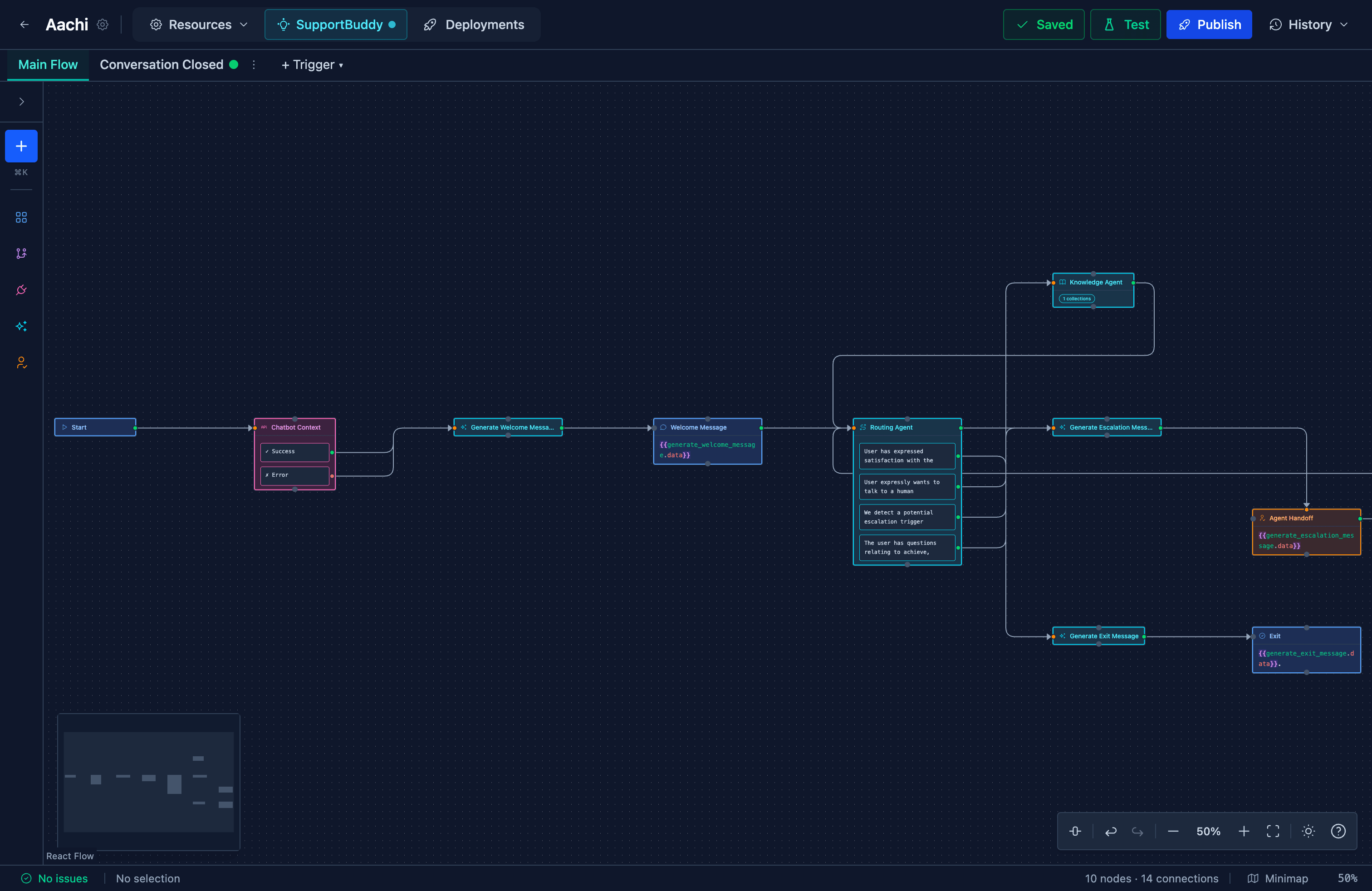
Design the conversation once.
Lay out what your flow asks, what it answers and where it branches, on a canvas you can read at a glance. Call your own APIs where the answer lives in your systems, and deploy the same design to every channel.
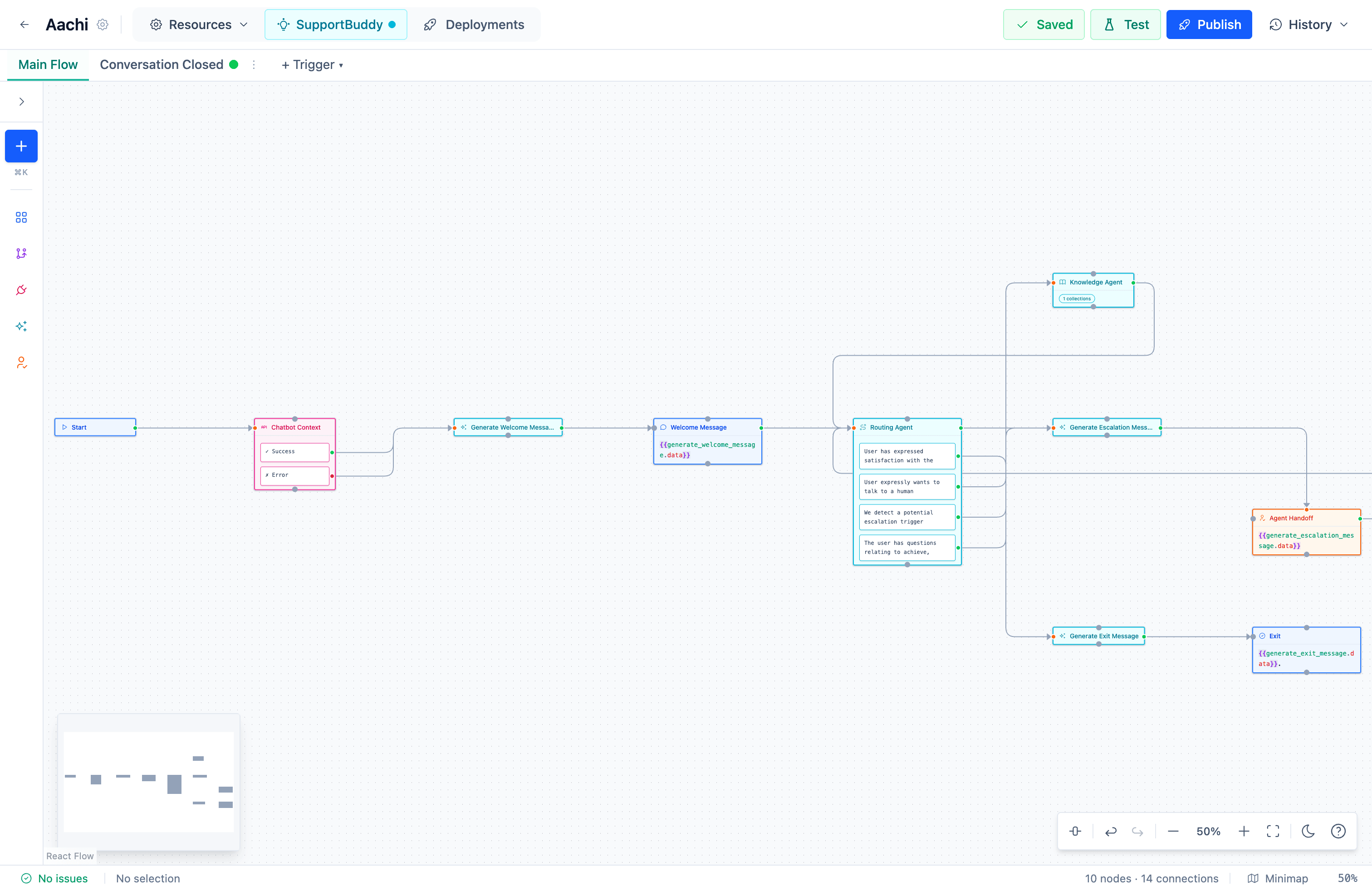
Lay out what your flow asks, what it answers and where it branches, on a canvas you can read at a glance. Call your own APIs where the answer lives in your systems, and deploy the same design to every channel.
Drag nodes onto a canvas and connect them. The shape of the conversation is the shape on the screen, so anyone on your team can read what a customer will be asked.
Themes, colours, typography, animation and a dark mode, so the chat widget looks like it belongs on your site rather than bolted to it.
One design, deployed separately to webchat, Intercom, WhatsApp and Telegram. Change the flow once and every channel gets the change.
Release a new version to a share of your traffic, targeted on attributes you choose, and widen it when you're happy.
Upload documents, PDFs and web pages. Any step in a flow can search your collections and answer from what it finds.
Somewhere to keep what a flow learns and what you want it to know. Look someone up when they come back, save what a conversation collects, and read out a menu or a price list you maintain yourself. No database of your own to run.
Run steps in the background when a conversation reaches a moment in its lifecycle. Nobody is waiting on a trigger, so it can record what happened, call an API, or tidy up a table, apart from the chat itself.
Step-by-step execution logs for every conversation. When something answers wrongly you can see which node did it and what it was working from.
A deployment is a flow plus a channel. The same design can run on all four at once, each with its own settings and its own rollout.
A widget on your site, styled to match it. Drop in a script tag or embed the conversation inline in a page.
Your flow answers inside the Intercom messenger, and hands off to your Intercom team with the tags and routing you configure.
The channel most customers reply on fastest. Same flow, same knowledge, no separate build.
A connection you set up once, after which Telegram behaves like any other channel.
A palette of node types, from the plain to the intelligent. Mix deterministic steps with AI where it earns its place, and read the whole thing back afterwards.
The same flows, deployments and test runs are available as tools over MCP and a REST API. Point an AI agent like Claude or Cursor at a workspace and it builds, publishes and deploys flows the way you would, or drive it from a script.
It reads the node types, lays out a flow, runs it in test mode to check its work, then publishes and deploys, all through tools scoped by a token you create and revoke.
A script or backend calls the same tools over REST, so a change to a flow or a deployment can run on a schedule or from your own systems.
We'll show you the builder on your own conversations. If you'd rather not build them yourself, we'll build them with you as a paid add-on.